The thesis: you do not need a stronger model, you need better routing.
Every time a new model ships, the same thing happens. Everyone switches to it for everything, on the logic that if it is better, it should do all of it. That is the most expensive way to work and also the laziest.
In Spend Less Tokens, vas, who runs Varick Agents, put down a line worth reading twice: 90 percent of a company's token spend never needed to happen. The reason is simple. Most workflows are deterministic. The steps are known in advance, the inputs are structured, the output is predictable. Run that through a frontier model and you are paying for reasoning on something that should have been a conditional in code.
His team builds agents for large companies and keeps hitting the same thing. A workflow that looks agentic from the outside turns out to be mostly deterministic once you break it apart. The number of steps in a workflow and the amount of intelligence it requires are two completely different quantities.
The pyramid
Split the work by how much judgment it actually demands.
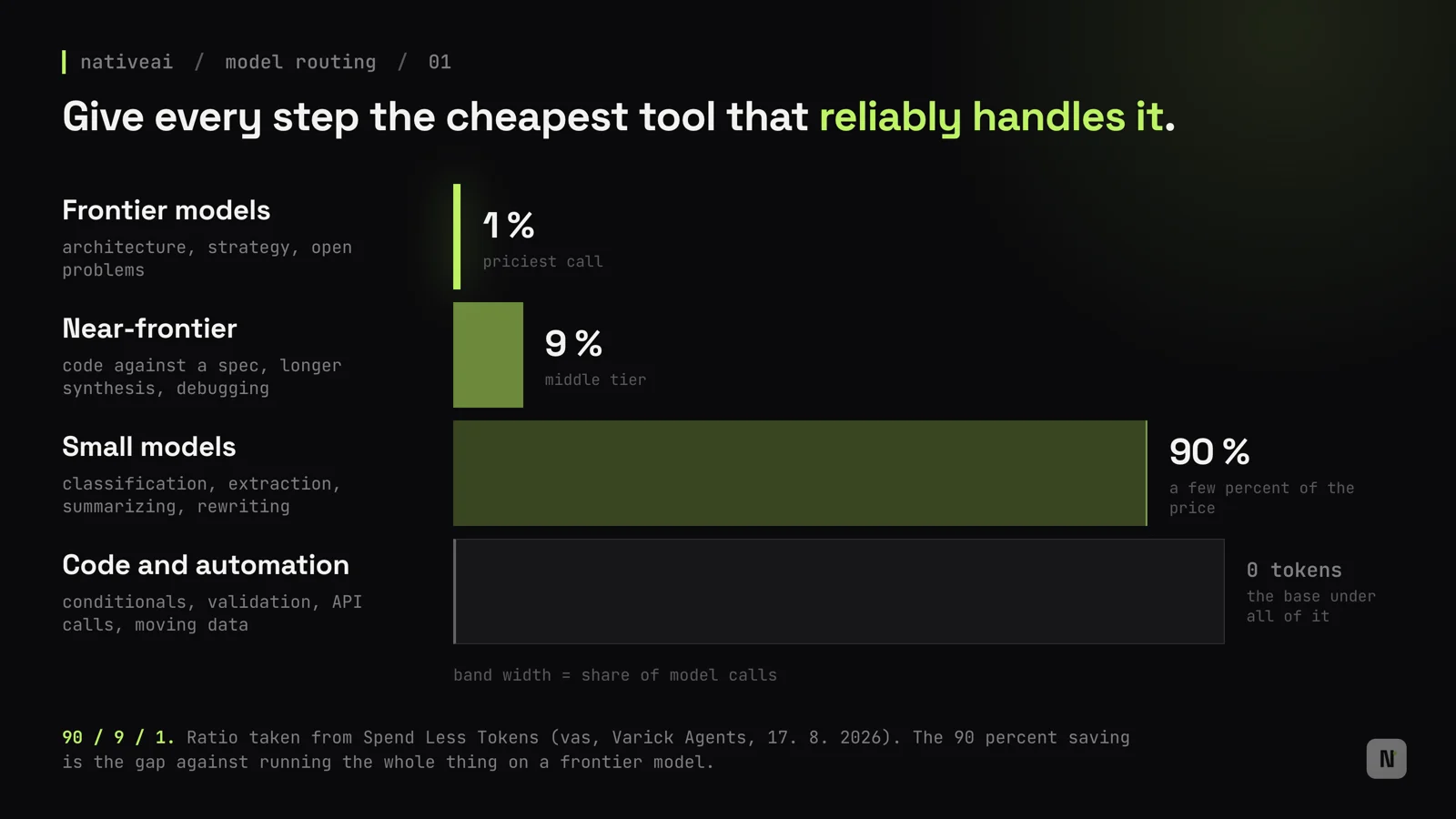
Code and automation (the base). Everything deterministic: parsing, validation, API calls, moving data, triggers, formatting. No model belongs here. If a step can be written as a function, it should be a function.
Small models (90 %). Classification, extraction, summarizing, rewriting, routing, short templated answers. Tasks where the correct answer is narrowly defined and cheap to check.
Near-frontier models (9 %). Several steps and some judgment, but clear context: writing code against a spec, longer synthesis, debugging a known failure.
Frontier models (1 %). Open problems, architectural calls, strategy, hard reasoning, synthesis across sources with no obvious path. This is the only tier where the higher price actually earns itself back.
He calls that ratio 90/9/1. The 90 percent saving he reports is the gap between that ratio and the scenario where everything runs on a frontier model.
The workflow is the wrong unit of automation
The biggest design mistake is not picking the wrong model. It is automating at the level of the whole workflow.
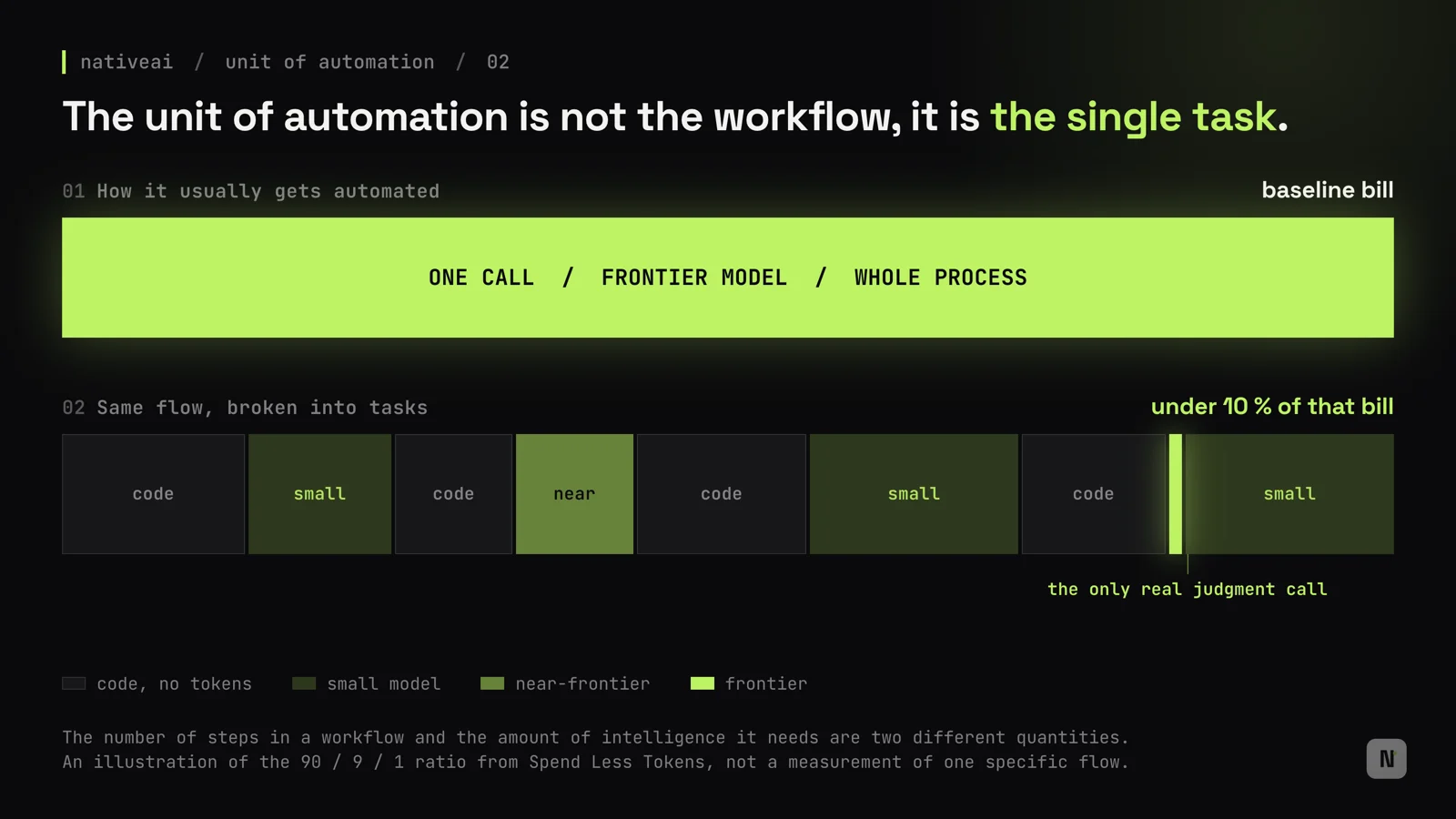
Give a model enough context and a few tools and it will work its way through a complicated process on its own. It works, so the problem looks solved. What actually happens is that the model is also doing the work in every place where it was never needed, and that is where the budget goes.
The right unit is the individual task inside the flow. Each task carries its own intelligence requirement. You need a model where the right answer cannot be known ahead of time, because it depends on the situation and there is more than one reasonable way to handle it. Everything else is a conditional in code.
Personal workflows sit at a different ratio
A company can afford to specify every step to the end and lock it down. In personal work (Claude Code, Codex, agents) you cannot, because the task is different every time and often there is no spec at all.
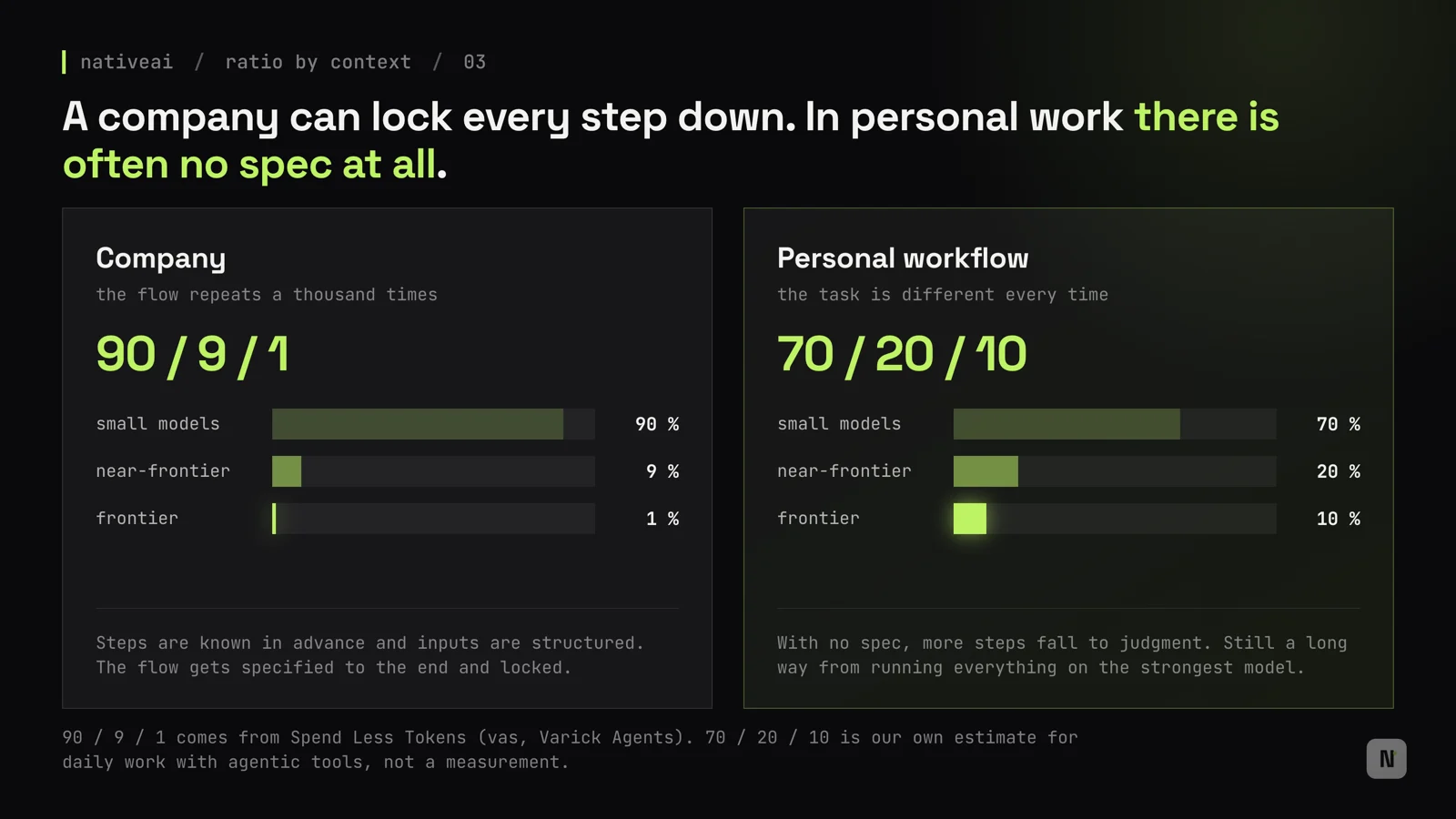
The realistic ratio is closer to 70 / 20 / 10. That is still an enormous difference against running everything on the strongest model, and it is exactly the difference between a subscription that lasts the month and one that lasts ten days.
What this looks like in practice
- Strong orchestrator, cheap executors. Planning, decomposition and the final call stay at the top. File search, bulk edits, boilerplate, tests and migrations go to a small model.
- Subagents return distilled summaries, not raw material. Every unnecessary token that lands in the main context gets paid for again on every following turn.
- Ask first whether this is a task for a model at all. A script you write once runs a thousand times at no token cost.
- Define the task instead of letting the model guess it. Most people reach for the strongest model precisely because the task was never defined. Guessing is expensive.
- Cache what repeats. The same input coming back every day does not need a fresh call. The result goes into a cache and gets read from there.
- Context is a cost, not a convenience. Anything that does not change the next decision does not belong in the call. Narrow context is also more accurate, because irrelevant information is exactly where models get confused.
Why this keeps getting more important
The assumption is straightforward. Models at the very top will not get cheaper, and every new generation pushes the previous one into a price bracket that is entirely sufficient for the large majority of tasks. Running everything on the newest model means paying a steep price for a difference you will not notice on 90 percent of the work.
The real skill is not access to the best model. The real skill is knowing exactly what you need, breaking the workflow into steps, and giving each step the cheapest tool that reliably handles it.
Expecting a big result out of a vague prompt is not optimization. It is handing your own work to a model that will bill you for it at the highest rate available.
Source: vas (vasuman), Spend Less Tokens, 17. 8. 2026, x.com/vasuman/status/2089436710257959073